Daemon Lover by H. R. T. Burns

Hot Off the Presses scours the internet for newly published debut books from unknown authors, and saves everyone else the trouble of actually reading books to find out if they’re good or not. New posts every Tuesday. This is meant for entertainment purposes only, not serious consumer advice. And there will be spoilers.

Welcome back from your long exile, far from the warm glow of my idiotic opinions. I for one am excited to be back. 2022 is going to have bonus content, end-of-year awards, possibly t-shirts. There won’t be t-shirts. But I’ve been forcing myself to read the latest self published offerings on Kindle through the holiday season, using the same will power that has allowed me to eat stale panettone, grin through racist tirades, and sit through enough showings of A Christmas Story to feel like Alex from A Clockwork Orange. To begin the year, we’re revisiting a classic subgenre: sexualized World of Warcraft, also known as “men’s adventure fiction” on Amazon, which means that this thing could show up in your customers-also-boughts when you buy a cowboy novel for your dad. I give you: Daemon Lover, by H. R. T. Burns.

“If I want your opinion, I’ll steal it from you.”

Daemona is a succubus thief in one of those standard fantasy cities where it’s always nighttime, and you can just grab an apple off a cart at the night market and nobody will stop you for some reason. Not sure why mama and papa succubus named their kid Daemona, but it fits. She gets a tip from her informant, human-rat hybrid Marcenko. It’s implied that he’s not actually part rat, but I’m not sure. This is always a problem I have with the first few pages of generic fantasy novels. You’ve introduced a main character who is some kind of devil-thing, complete with horns, and you expect me to know the short guy with an overbite is a rodent in spirit only? I can’t read your mind, H. R. T. Burns. He gives her a tip on a sweet elephant jewel in an octopus tower that has no guards and is totally not suspicious at all. But then it turns out there’s a golem guarding the sweet elephant jewel in the octopus tower with no guards! Luckily, our protagonist is a kicky flippy badass who is effortlessly cool and good at everything. Specifically, she can teleport. Poof, gone, teleport. Of course, she can’t just teleport anytime, anywhere, without consequence. She has a finite amount of teleporting energy, which has to be replenished by semen.
OK, I may have skipped some critical parts of the first chapter. Our story actually began with the first of many scenes in which Daemona has awkward and very expeditious sex with some rando. I am not complaining. The way this usually works is that I take time out of my day to curl up with a good book that explains to me how each wrinkle on Lord Bargnarg’s manhood feels passing Lady Fningwig’s uvula. Then I have to take a deep breath and promise myself that fearless emotional inventory I’ve been putting off. Any day now. The sex scenes in this book linger about as long as a Wikipedia article on a village in Poland. In, out, next disposable bowl-cutted farm lad. So the golem. It was a trap, laid by the captain of the guard, Harlin. But Harlin’s not looking to simply lock up his sexy thief nemesis. This was all a ruse to get her in front of King Graymont. The king’s daughter Tamarind was kidnapped, and his other daughter Skyrim got kidnapped chasing after the first daughter. No word on how many previous daughters burned down and fell into the swamp. By his order, Daemona, Harlin, and a third companion Obvious Werewolf team up to go find and bring back as many daughters as they can carry.

“I’m looking for some wood.”

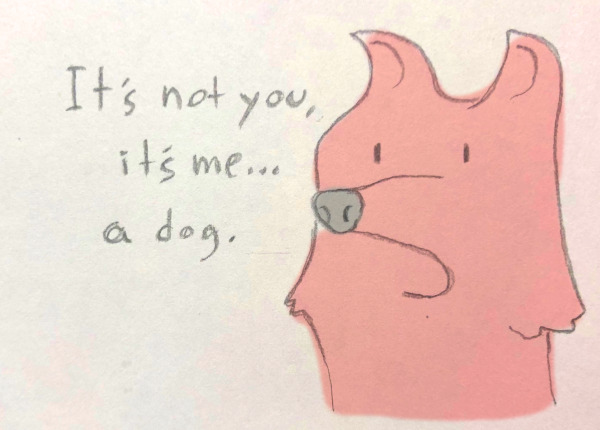
The trio gears up, and Daemona helps herself to a quick release stable boy. A pinch, a twist, a circular motion, and voila, she is recharged. There’s a pattern of premature ejaculation in these scenes, presumably because Daemona is just so sexy, but again this is to my benefit. I’m pretty sure we don’t even get one single horse disturbance in this entire book. The journey kicks into high gear when they meet an ogre friend Tish, who makes a portal to help them escape the black soldiers of the Gray Sovereign. Tish also calls her slutty, which confuses me. What constitutes a “slutty” succubus? How does slut shaming even work in a genderless species living in a world populated by sex demons? There are some fights with random minibosses wielding D&D weapons, and more teleporting, and soon Daemona needs to recharge. She calls Harlin a cuck when he refuses to sleep with her, and also she gets rejected by a dog.

The saucy banter between Daemona and the supporting cast is a big part of the book. Unfortunately, none of it really lands, except for the part when Daemona fails to convince a dog to have sex with her. The rest of it was Tarantino-style zippy one liners that were maybe trying to be funny, or cool, or both? I’m not sure. You may have also noticed a sort of Frankenstein’s monster of sex positive girl power liberation and gross normative gender roles. Your girl loves some love-em-and-leave-em leading ladies, but the problematic aspects of a Han Solo archetype don’t get any better when you swap out the hardware. Maybe I’m overthinking it because the truncated sex scenes have prevented my brain from shutting down in self defense.

“The hunter is now the hunted.”

Long time reader(s?) of this blog will remember the award winning classic Monster Girls Unlocked, in which a young nerd finds a way to bang his professor in virtual reality. In that masterpiece we all have to watch Professor McTits and every other woman in the world throw themselves upon the altar of this guy’s sexual preferences. I’ve read plenty of books where the main character’s fetish is red flags, or where flagrant abuse and self-indulgence stand in for romance, so I was braced for the inevitable scene in which her boobies were just too big to fit through the sewer grate, or a lovingly presented scene in which an ogre dungeon guard doesn’t understand consent. To my slack jawed amazement, this book actually takes the main character’s perspective seriously, treating her as an agent of the plot rather than a vehicle for gaze-y fan service. I mean, there’s obviously fan service. I don’t mean to give the impression that you won’t get the slippery meat slapping you came for. But the author, in a strange twist of fate, seems to understand that their personal desires, the perspectives of the major characters, and the rules of the universe they’ve made, may not all be the same thing.

Not that Daemon Lover is great literature. In general the writing feels rushed. There are missing verbs, and H. R. T. Burns has a habit of spelling “the” as “eth.” It took me way too long to realize that wasn’t some Hogar-style archaic word I didn’t know. Amateurism is not a mortal sin in a debut author, and I am almost ready to say that I am curious what they do for their sophomoric installment in the Daemona series. This is one of those guilty pleasure books that scratch a secret, shameful itch many of us have for erotic fantasy. It’s cheesy; the “hilarious” banter sucks. But it manages to walk the fine line between dumb sexy fun and just dumb. It’s way too short for the five dollar price tag, but if the price ever comes down I would give it a careful recommendation to anyone who wants their erotica to contain more premature ejaculation and fewer horse disturbances.

I sat through another one of Madeline’s dumb reviews, and now you do, too.

Review: The Entire State of Minnesota

Hot Off the Presses scours the internet for newly published debut books from unknown authors, and saves everyone else the trouble of actually reading books to find out if they’re good or not. Except when I am jet lagged or reeling from getting the reading-center of my brain blended with a Q-tip, and start babbling about random nonsense. New posts every Tuesday. This is meant for entertainment purposes only, not serious consumer advice. And there will be spoilers.

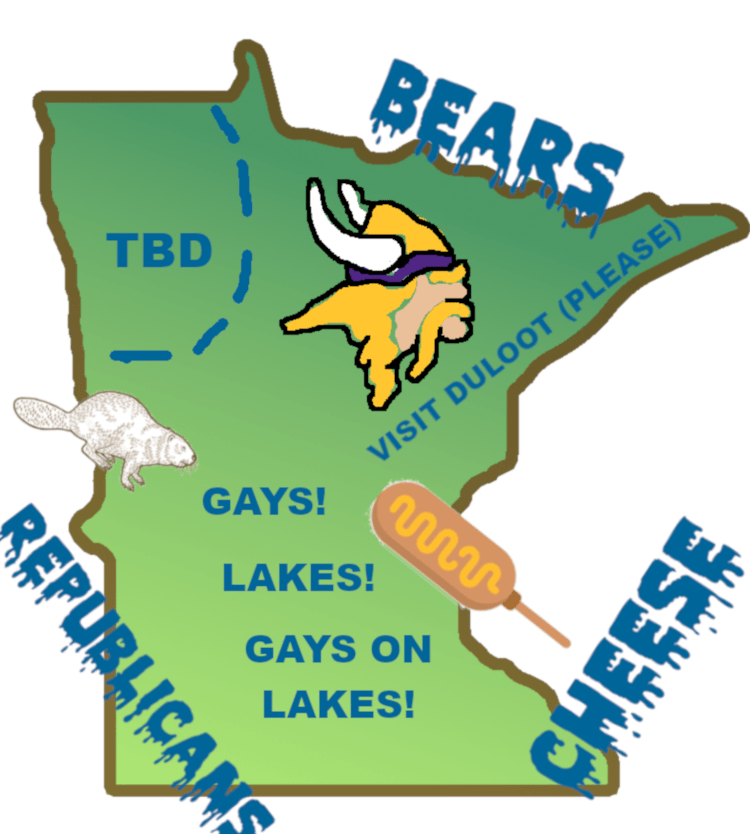
This one’s a little different. Normally I review books on this book review blog, but I’m in the middle of an airplane relay race across the world, so today we’re going to be taking a look at the Gopher State, the land of ten thousand lakes, the land that seasoning forgot, Minnesota. That’s right, stick around and you will get to hear many, perhaps even most, of my opinions on the North Star State.

Minnesota is famous for being a very progressive place, in local quirky ways. Sure, you can have gay sex in church and slavery in all the history textbooks, but try to buy a bottle of red wine at the grocery store and people will look at you like you’ve come to a playground to score Fentanyl. It’s an open society, but only to an extent. The fact is that anyone who doesn’t look like Bill Fagerbakke from Coach is a guest in Minnesota. That’s the strength and the weakness of their tolerance. Guests don’t have to ask for the good towels, or affordable healthcare. They get it as a matter of course. But by the same token, guests don’t ever belong, no matter how long they stay or how many legal gun permits they have in their glove compartment. It’s truly a land of contrasts. Let’s take a look around, shall we?

“I will always live in Minnesota. It’s so cold it keeps all the bad people away.” – Prince

Minnesota as we know it was founded by Scandinavians seeking greater hardships than could be provided in Europe. They must have been thrilled to find the place full of loons with their terrifying red eyes (fun fact: loons are the only state bird to feature in my nightmares). Ultimately they went on to invent the toaster, the shopping mall, and Prince, twice. Before Prince, their main recreational activity was Lutheranism. Studying the history of Lutheranism is very difficult, mostly because of the names. Let’s say you’re a Lutheran, but you have serious misgivings about the way other Lutherans Lutheran, because of course you do; you’re Lutheran. So you take down the old sign in front of your church and put up a new one with a new name. That’s the best part, picking a new name. But you have to follow certain arbitrary rules, because of course you do; you’re Lutheran. Besides “church” and “Lutheran” there are five permissible words: Evangelical, Synod, Joint, General, and Norwegian. You can use all five, in any order, but they cannot be repeated. This means there are five factorial possible names (don’t check my math). There are many more than five factorial Lutheran churches, so many of them have to have the name of a state thrown in for clarification. Not the state they’re actually in, of course, that would be confusing. If you’ve ever been to Concordia University, you know that it’s a whole series of universities associated with the Lutheran Church Missouri Synod, scattered all over the country, from coast to coast. Guess which state does not have a Concordia University. Go on, write down your top three guesses. Did you pick Missouri? Correct! Minnesota is famously full of liberal Lutherans, except the Minnesota Synod thought that mainstream Lutherans were too liberal, so they joined a more conservative group named after Wisconsin that was at the time based mostly in Missouri, not to be confused with the above-mentioned Missouri Synod, which is today based mostly in Nebraska, despite the fact that the Nebraska Synod is part of the main liberal Lutheran super-group that includes most Minnesotan Lutherans.

“Afterwards they would stroll home through the balmy air of August night, dreaming along Hennepin and Nicolett Avenues, through the gay crowd.” – Minneapolis native F. Scott Fitzgerald

The beating, mayonnaise-clogged heart of the state is the twin cities, Minneapolis and St. Paul. Minneapolis has a singular mission: to be obnoxiously perfect. This is where you take the effortlessly functional public transportation down to the artisanal ice cream shop, secure in the knowledge that your corroded arteries will be reconstructed at a world-class hospital by a handsome surgeon who escaped the Syrian Civil War. Cute brick condos full of working class Communists line the maple-shaded boulevards. Everyone’s smiling and waving at nothing. It’s awful. Then there’s St. Paul. Good Ole St. Paul, where every street looks like an establishing shot on Roseanne. Every few years the people of Minnesota come together and try to find the one person among them who is not nice. They name this person “Governor,” and quarantine them to St. Paul. One time the flour mills in Minneapolis dumped thousands of tons of flour into the river and it made a raft of rotten wheat paste that floated down stream a little ways and then settled along the shores of St. Paul. I’ve always felt like the gelatinized glob of mold and dead rats made the right choice.

“If you’re smart enough to go to college, you should be smart and creative enough to pay for it.” – Jesse Ventura, former Governor of Minnesota

The North Woods, Minnesota’s Minnesota, where your best source of vitamin D is a 60-watt bulb, is another distinct region. At some point this must have been the least desirable part of the state, because it has a large concentration of Native Americans. Parallel to the tradition of displacing Natives is the tradition of losing track of where you put them, resulting in the hilarious Northwest Angle, in which a cartographic error has cut off the Red Lake Indian Reservation from the rest of the United States. I’m sure the locals are very broken up about it, super for real you guys. They really wanted to go to your problematic holiday booze-up, but oops, cartographic error. Next time, for suresies. The Dakota and Ojibwe, among other groups, are not as enthusiastic about some of the cultural practices of their Settler neighbors to the south, such as genocide or potato chip-based salads, and maintain their own cultural traditions. Chief among these is the elaborate prank they have been pulling on the rest of the country for years, in which they pretend that wild rice is a food, and sell it to credulous Waabishkiiwed as a healthy alternative to edible rice. Their ability to keep a straight face while White people put this stuff in their mouths and bounce it around a few times is nothing short of astonishing. The main city of this region, Duloot, is currently in the middle of a Hail Mary play to attract tourism, having lost its industrial base, fishing rights, shipping, football team, Bob Dylan, and self respect. You can only trick a person into visiting Duloot once, so this places a cap on the number of tourists the city can attract. Nevertheless, they have built numerous shops and restaurants along their post-industrial waterfront, where you can buy leftover iron ore and wild rice. Presumably neither goes bad, so no hurry.

Above: current Minnesota state flag. Below: my favorite version of the popular alternative.

Minnesota to English Translation Guide

“hotdish” – shepherd’s pie, but with tater tots

“oofda” – expression of surprise, not a sex maneuver

“duck, duck, gray duck” – game for children with limited vocabulary

“Camp Snoopy” – surprisingly also not a sex maneuver

“crane” – stick of colorful wax used for drawing

“Juicy Lucy” – still, STILL, not a sex maneuver

“salad” – corn flakes in aspic

“meat raffle” – definitely a sex maneuver

While it is sometimes frustrating trying to convince people that the tropical rainforest does not begin at Iowa, and that slavery does not persist in the South (we cut it up into its constituent pieces and sprinkled it across the whole country years ago), the earnestness of Minnesotans is infectious. They deserve their reputation for kindness, and I am constantly amazed at their completely unanalyzed assumption that people generally do good things. It feels like being a supporting character in Come From Away every time I visit. For an inveterate hater like myself it’s kryptonite, draining my powers of cynicism until there’s very little left. Everyone should experience that at least once in their life. You should go. But bring gloves. I’ll catch you up on what I’ve been reading just as soon as I can figure out what day it is and what country I’m in.

I am now a certified expert on Minnesota, and I’m not sure how to feel about that.

Last Kiss in Tiananmen Square by Lisa Zhang Wharton

Hot Off the Presses scours the internet for newly published debut books from unknown authors, and saves everyone else the trouble of actually reading books to find out if they’re good or not. New posts every Tuesday. This is meant for entertainment purposes only, not serious consumer advice. And there will be spoilers.

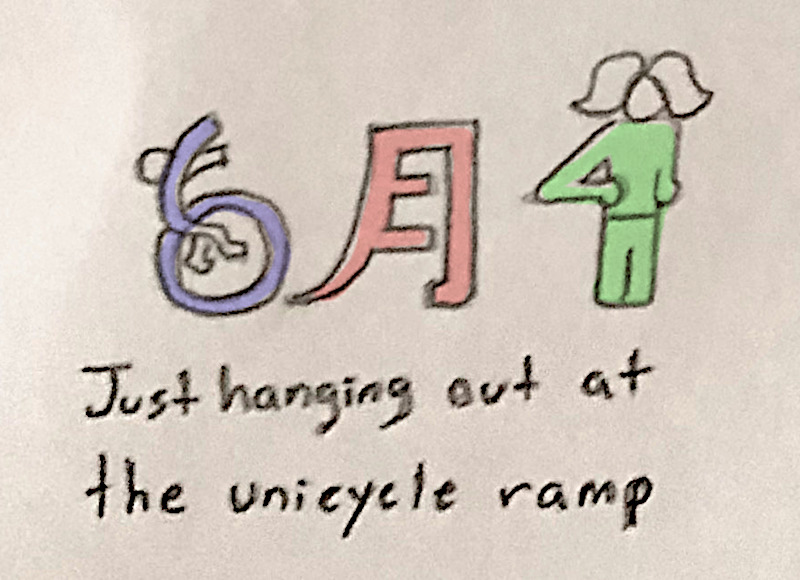
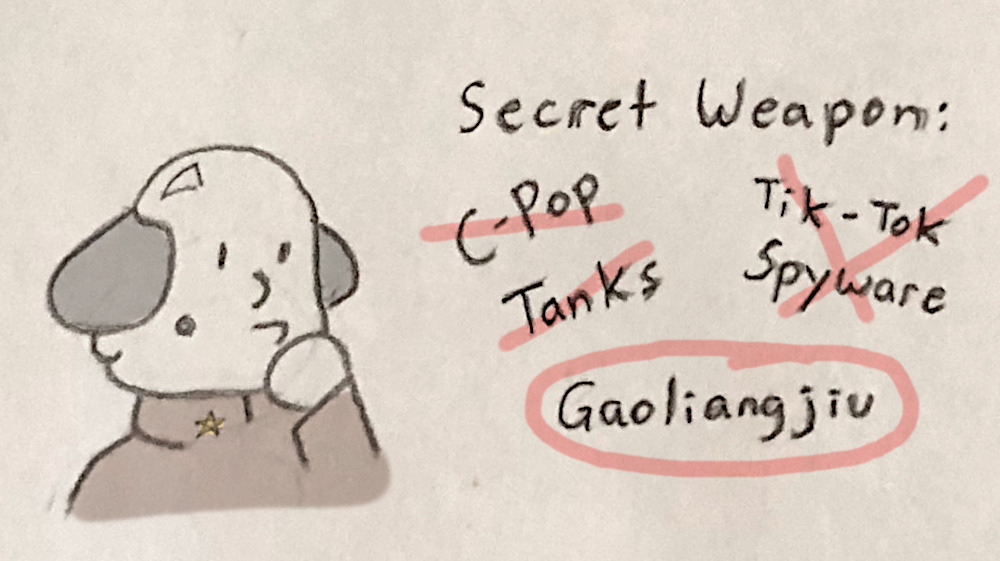
Today we’re talking about China. Glorious China. Not Taiwan. The PRC. They have the best China, the biggest China you’ve ever seen. Let me explain. Lately about 3.8% of my traffic has been Chinese users who have found me on Baidu. Other search engines provide less than 2%, because of course they do; I’m not exactly a hot commodity. So something is causing Hot Off the Presses to generate buzz in China, and that led to today’s experiment. I want to get banned in China, not because I don’t want the lovely people of that country to read my content, but because not being banned by the PRC feels gross. It’s like finding out you were on Charles Manson’s approved visitor list. Actually, now that I type that I would have loved to be on that list, but it’s not the same. Anyway, I wanted to know what happens if I review a book that has “Tiananmen Square” in the title, so here we are. Last Kiss in Tiananmen Square by Lisa Zhang Wharton is a slice-of-life historical romance set in 1989 during the large scale student uprisings in Beijing in the late spring of that year.

“A new world appeared in front of Baiyun. She did not know what it was yet, but it was becoming clearer and clearer.”

Our main protagonist is Baiyun, a university student dealing with family drama and daily challenges in the bustling, chaotic city. Her home life is strained by her father’s mental incapacity and her mother’s conga line of boyfriends. At school she makes the most of the austere facilities and hectic schedule. Our extended introduction to her life carries through a long description of using the common showers and lackluster cafeteria with her dormmate, resident slut-bucket Yumei, until the pair is yanked from their routine by students ominously handing out flyers about the death of reformer Hu Yaobang.

Zhang Wharton pays close attention to the food, from the crappy cafeteria fare to her mother’s reheated leftover stir fry, and this goes a long way toward making the setting feel real, but it also put me in my familiar “prepare to flinch” stance, because these are college students we’re talking about, and it was only a matter of time before these food descriptions turned to a proper Chinese booze up. Gather round the good chair, children, and listen to the story of that time your weird aunt who is no longer invited to Thanksgiving for reasons we won’t get into here was introduced to gaoliangjiu. Somewhere in Shandong province there is a factory that makes paint thinner. Any batch that is too astringent to be used as paint thinner in a closed room without PPE gets sent to the rat poison factory down the road. Sometimes you don’t pay attention and your rat poison goes off, and the only thing to do is send it down the road to the baijiu factory. And every once in a while, just once in a blue moon mind you, you get a rusty bucket (I assume it comes in rusty buckets) of flammable rot gut that is unacceptable to the delicate palate of the discerning baijiu customer. When that happens, you distill it one more time, vent the fluorocarbons, strain out some of the mice, and slap a label on it that says “gaoliangjiu.” Gaoliangjiu is a palate flenser* that offers no escape. You can’t mix it with juice, because whatever you add will either curdle, cook, or sublime directly into a gas and escape. It’s like if you stuffed a filing cabinet full of plastic waste, set it on fire, and threw it down a spiral staircase, only the staircase is your esophagus, and when it hits the bottom all the drawers fly open releasing angry bees.

*You try writing jokes every week and see if they’re all winners.

“During the five years of re-education in the countryside, he had worked hard. He wanted the sweat to wash away his sorrow, and the soil to bury his grief.”

Where was I? Ah, yes. Next we are introduced to Dagong, the son of a business owner who has been beaten down by the Cultural Revolution. He is now a middle aged engineer, living in a crowded building that was once his deceased aunt’s home and playing too much chess with his friend Lao Liu. Lao Liu is a disaffected cop, tired of busting teenagers for agitating for a better life. Both men feel that there are political winds shifting, and Dagong wonders for the first time in decades if real change might be possible.

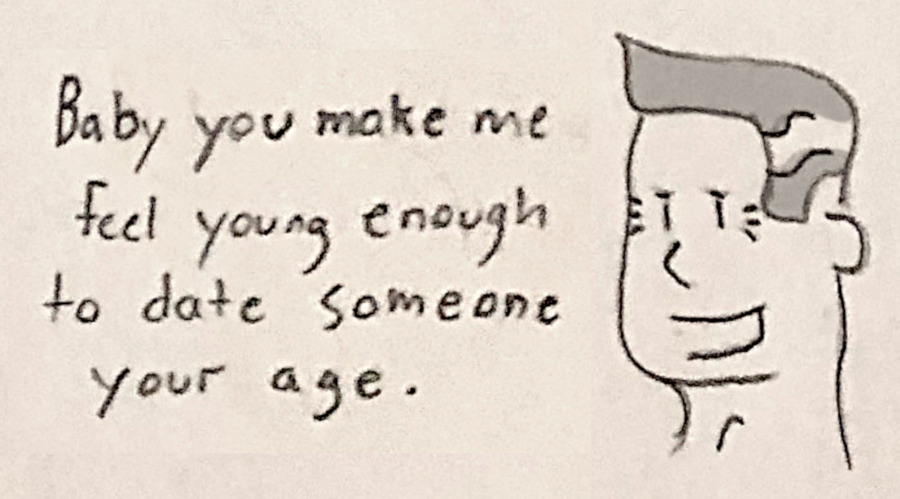
Dagong and Baiyun run into each other when they find themselves swept up in a student protest on a chilly, wet day. Dagong offers to take Baiyun and Yumei away on his bicycle before the latter gets hypothermia, and later spends more time with Baiyun. The two wander the university campus and catch a popup concert by a young rock star. Baiyun is flattered by the attention of the handsome, chivalrous older man. We learned in an earlier chapter that she’s into older men anyway, and is still getting over her romantic feelings for one of her mother’s previous boyfriends. Dagong for his part feels rejuvenated, woken up by the passion of the student movement, and the beautiful young woman in front of him.

I already mentioned that the setting feels very real. The daily habitus of life in late twentieth century Beijing is laid out in intimate detail. There are scenes in which traffic cops try to regulate how many people can ride on the same bicycle (apparently being able to fit a lot of people on your bicycle was a major preoccupation at the time), and cyclists happily ignore them. It’s charming, but not nostalgic. The book gives a powerful sense of being in the middle of something large, amorphous, and energizing. I’ve seen criticism of the 1989 student protests that boil down to not having a very coherent set of ideals other than the vague demand of reform, but this is often how grassroots movements work: no one is steering the bus, and no one is even sure where the bus is going. Also, there is one guy on the bus who is convinced that every demonstration he goes to is an invitation to rant about the electoral college. Give it a rest, Warren.

“‘Even a dead man like me can come back to life,’ said Dagong.”

I take democracy for granted, and deep down I probably take authoritarianism in China as a given as well. Living as I do in a country that slaps you with one hand and pats you on the head with the other, I can sort of appreciate the Chinese government’s complete lack of pretense. Google the Great Hall of the People where the National People’s Congress meets. It’s literally an auditorium. Like, the kind you would have pep rallies in. You know how, when there’s a play happening on stage, people in the auditorium will raise their hand and contribute a constructive idea? Remember all the times you’ve seen that happen? Whoever built this thing was like “Yeah, nobody’s gonna need to have a two way conversation in this room.” Beautiful ceiling, though. Communists consistently have better ceilings.

I don’t know if stories like Last Kiss in Tiananmen Square make the problem of authoritarianism in China feel more immutable, because so little has changed in thirty years, or more urgent and immediate. Either way, this was an engaging love story with likable characters and a fascinating setting. It’s three dollars on Kindle. I don’t know if Amazon is blocked in China, or if you can get the book on Alibaba, which seems inconvenient. But I’m sure if anyone in the PRC had a problem with their government’s internet policy, we would have heard them complain about it online by now.

I’ll be traveling too much in December to post, but I will be sure to keep up with whatever Amazon throws at me and get back to you in January.

I sat through another one of Madeline’s dumb reviews, so now you do too.

Love and Pollination by Mari Jane Law

Hot Off the Presses scours the internet for newly published debut books from unknown authors, and saves everyone else the trouble of actually reading books to find out if they’re good or not. New posts every Tuesday. This is meant for entertainment purposes only, not serious consumer advice. And there will be spoilers.

Oh, boy! My first real-life grown-up book tour! I feel like I should make some kind of clarifying statement about receiving money to review this book, but they didn’t pay me anything so I can’t. Nevertheless, your girl is big time now. If you try to call me, prepare to be deflected by my secretary who has strict instructions not to interrupt me at the ashram. As opposed to what currently happens when people try to call me, which is that I don’t pick up because I’m nervous, then I feel bad that I haven’t called you back until finally I am so paralyzed with guilt that I delete your number and pretend my phone is broken. Speaking of social dysfunction, Love and Pollination is a tongue-in-cheek romantic comedy about a young woman in modern day Bristol trying to find love, or get rid of it, or possibly just make honey.

“Historically, when men kidnapped women, didn’t they have to marry them afterwards?”

This is one of those books where the timeline moves back and forth a little bit. I know I’ve set the precedent that nothing on this blog ever makes sense, but I’m gonna try to hold this nineteenth century railroad bridge of a plot together with my bare hands. The story begins when our main character Perdita is fired for refusing to throw little old ladies (or at least their finances) into traffic, which either means we’re meant to understand that she’s the good guy, or we’re setting up a fall from grace where she starts chucking grandmas off the Pensford viaduct. Perdita commiserates with her two friends Gavin and Luke. I can’t be a hundred percent certain that they are her Sassy Gay Besties, because they both appear to have jobs and, you know, stuff to do with their day besides prop up the trainwreck protagonist, which would sadly disqualify them.

“Perdita hid the detector stick behind her back… ‘If you don’t want a child, you shouldn’t play grown-up games,’ the woman told her as she shook her hands above the sink…”

If you’re anything like me, you hold two drinks at parties so no one will try to shake your hand. But more to the point if you’re like me minus the crippling dread of human contact, you’re probably wondering about the name Perdita. Perdition is an SAT word meaning damnation or punishment. Some guy named Bill who can’t spell his own name the same way twice made a character like that little kid in Room, and named her Perdita. Since then a small number of parents have thought that it was appropriate to name their child after either the state of eternal damnation or a girl who grew up in the medieval equivalent of Joseph Fritzl’s basement, keeping the name alive through the generations. However, like Chip, it’s a name that primarily exists in fiction, in this case to demonstrate that a character is a) female, b) British, and c) put-upon, with the main example being the lady dog in 101 Dalmations. So we have a fictional character who’s about to have a really rough time. Also, it’s a genus of bee, which may not have anything to do with it, but I don’t know what kind of fourth dimensional chess Mari Jane Law is playing here.

Before we can get bogged down in a montage of makeovers, pillow fights, and performative allyship, we are whisked away to our other perspective character. Saul is a big giant man whose aunt Violet was one of those ladies who were not saved from traffic in time by Perdita’s sudden moral clarity, and lost all her money. And he’s salty about it. Big salty Saul can’t find Perdita to yell into her face about his feelings like a crazy person, because she’s been fired, remember? This book is basically Primer, try to keep up. But luck! He runs into her at a necktie and scarf store. This leads to the most bananas romcom meet-cute I think I have ever read.

Big Saul’s big plan is apparently to abduct Perdita in big broad daylight for reasons unknown. When a concerned stranger approaches, because I’m pretty sure you’re not allowed to kidnap women in Woolworth’s, Saul decides to try a Wile E. Coyote strategy of pretending that Perdita is his amnesiac wife who has forgotten her meds and wandered off saying crazy people things like “help, I don’t know this man.” Now in the next scene Saul goes to prison, but here’s the thing: he doesn’t though. It works. The concerned stranger looks at the giant angry man holding a woman by the arm while she yells for help, and thinks “Well, I guess this all checks out.” Don’t tell me people in England haven’t heard of lying. The only word in “The United Kingdom of Great Britain and Northern Ireland” that isn’t misleading is “the.” Once outside, her giant assailant insists that Perdita come to Violet’s house to face the music for what she has done. And she agrees, because she feels guilty. So to recap, you can straight up abduct a lady, and if that gets too taxing, you can just ask nicely and she’ll finish the job for you. There’s no way to not get a frightened woman into your car in Bristol. Also, there’s a chapter break in the middle of all this for some reason. I think I need you to just imagine the words “for some reason” at the end of each sentence, because I’m going to get tired of typing it.

“His warm man-scented breath fanned her cheek.”

At this point we fire up the flux capacitor and go back several months, to when old lady Violet and Perdita first met. Violet tells Perdita that she’s a flower who needs to attract a bee. She should wear more makeup at work so she can snag a man with a good job and not end up “unpollinated” like her. Since Perdita is an entire human woman, she should be immune to this, but alas, she is the product of Catholic education. This is something I didn’t know they had in other countries, but here in America Catholic sex education could be set to Flight of the Valkyries with no information loss. Rather than knowing things and facts and stuff, Perdita is left to envy the other girls in high heels and tight skirts soaking up all that sweet male gaze, and thinks that this old woman spouting relationship advice from the Talmud might be on to something. It turns out, Violet is scheming to set her up with her enormous nephew Saul. Instead, Perdita takes this advice, becomes a fully tarted up sex flower, and gets stung by some jerk who disappears for most of the book and moves on to a blonde, if you can believe it! Back in the present, Saul continues to press Perdita like she owes him something, and they come to an insane arrangement that ensures they are in close enough proximity to make the plot of a romance novel happen. Eventually it comes out that she’s protagonisting for two, which she insists on calling “being pollinated” instead of pregnant, because it “sounds nicer.”

I read a “dark romance” a few weeks ago in which the protagonist’s world revolved on an axis of throwing every terrible thing possible at her, and I couldn’t stop thinking about it while reading Love and Pollination. Of course, where dark romance has rape and forced abortions (it’s a whole thing, really you’re better off leaving that rabbit hole unspelunked), this sort of book pummels its main character with one of those squeaky toy hammers, presumably to the tune of Herb Alpert’s Spanish Flea. You know that nothing truly awful is going to happen to Perdita, despite the nominal determinism of her becoming a tragic heroine, and everything is going to be alright in the end. And without spoiling too much, of course it is. I cringed at a few of the jokes and the way some of the characters talk about sex, but after a while something strange happened. This book is so earnest and good-hearted, whether it’s dipping its protagonist in acid, buying her a nice seafood dinner, or subjecting her to dad jokes, that it’s hard to stay mad at it, even when a kidnap victim with a third grade education being turned into an indentured servant is played up for laughs. I didn’t hate it, and that rarely happens when I pick up a romance novel. Check it out if you’re the sort of person who loves murder mysteries where the cover is a watercolor of a beach house, and you want some wholesome, cheesy romcom fun. It’s five dollars on Kindle.

I sat through another one of Madeline’s dumb reviews, so now you do too.

Man-Made Escape by H. M. Stanton

Hot Off the Presses scours the internet for newly published debut books from unknown authors, and saves everyone else the trouble of actually reading books to find out if they’re good or not. New posts every Tuesday. This is meant for entertainment purposes only, not serious consumer advice. And there will be spoilers.

It’s not all parkour and revolution, being special. Sometimes it can be quite stressful. Man-Made Escape by H. M. Stanton is a YA sci-fi novel about a girl who really needs a vacation from living in a dystopian, engineered society.

Dahlia22020302 lives on a planetoid thing in the near future exactly three hundred years after Covid hit the eastern seaboard (that’s not a plot device or anything, it’s just how I measure time), along with her friends Friend220375974 and Friend2247504416. She is about to turn eighteen (just like you, reader!), which means she will soon have to take the aptitude test that will determine the job she does for the good of the planet, forever. Her hope is to be assigned to the Chronicle building, where her thirst for knowledge about the past can be satiated. She feels more comfortable around old books than around most people (again, sound familiar?)

“Ginormous awkward objects float down the street.”

As someone dumb enough to have multiple history degrees, I can relate to the romantic allure and mystery of the past. You put on your cute little pith helmet and machete your way through moldering tomes of ancient knowledge, expecting to find the ivy-clad pillars of distant societies: wood paneling, mustache competitions, maritime discipline. Instead it’s mostly an exercise in organization and data entry, with exciting episodes of frantic searching for notes on racist memoirs or arguing over the phone about collections too delicate to be pressed between the calloused, non-virginal fingers of a real human. Give it a month and our intrepid chornonaut will be begging to return to her dystopian Saved By the Bell remake.

Of course there is more at stake than simply failing a placement test and being doomed to wring out the sweat towels inside mascot costumes for the rest of her life. Dee is also afraid that the Founders, who run the world with brutal efficiency, will discover her transgressions against social order. These include her two secret friends. You’re not supposed to have friends on this planet. There is a girl who has sat next to her in class for years whom Dee does not know in the slightest. How you’re supposed to keep a friendship a secret when the kids apparently all go to school together and eat lunch together is beyond me, but I guess they use hand signals under the table or something. And what kind of YA protagonist would she be without inexplicable visions? D has a recurring dream about a soldier who seems to have some connection to the past.

This is where the story misses the Divergent mark. Divergent, for all its faults, was based on a brilliant premise. You need your YA protagonist to be special in some way, and have plenty of opportunities to do amazing things. But they also need to be relatable. What if you make it so that your protagonist is a super special person by being exactly as ordinary as the reader? It’s frankly a genius move, and those books probably would have redefined the genre if they hadn’t killed it instead. That’s the significance of the placing ceremony; but here the fact of the ceremony is divorced of its literary purpose, like Tolkienian elves in a David Eddings novel. Dee is a space alien living on a space alien world, and has to find other ways to serve as a reader insert.

“I take another drink. It is fruity and sweet. I have never heard of wine before, and I think I like it.”

But really, this is a throw back to way before Divergent. Utopian settings are almost inherently distasteful to teenagers. At least since the early 00s YA dystopia has been less about seemingly perfect societies gone subtly wrong, and more about societies that are obviously broken. Imagine the difference between The Giver and The Hunger Games. Actually, that would be a really fun cross-over. Katniss grows up in happy, pleasant District 12, only to discover that Peeta is so good at hiding because everyone’s color blind, and colicky babies are secretly forced to fight to the death. I’m calling dibs on this one right now. Don’t nobody NaNoWriMo my idea out from under me, I will cut you.

The one thing I do find very relatable is the fact that she is constantly terrified of everything. Anxiety is her horcrux. She spends a good portion of the book agitating her acid reflux over one imagined danger or the other, from state punishment and separation from her friends, to power outages and VR headsets. Can’t trust Teacher85857742631. Can’t trust your own sleep. She’s basically a human mouse.

“I am very plain and boring. Luckily, I only have to see my reflection once a year, during our annual physical.”

I don’t have to tell you that Dee gets her wish of working at the Chronicle building. The Founders take an interest in her early on, though it is unclear if they are curious about her high test scores or something else, and she is whisked away to begin her training. When she is introduced to videos of old Earth, we get a gonzo description of what I assume is a recording of a mall Santa, just to give us a taste of what marvels await her as the curator of her people’s past. Alternatively, this might be how they weed out the people who aren’t serious about spending the rest of their lives hunched over an IKEA desk trying to read the handwriting of dead racists until their eyes bleed. Hypothetically speaking.

For the first third or so of Man-Made Escape I was bored to tears. Stanton has a way of describing things in the most basic way possible, like Hemingway editing Simple English Wikipedia. We get general information about size and color, our protagonist’s emotion (unease), and occasionally something about what the latest metal hallways looks like. But it gets better later on, as the problems weighing on Dee compound. Once the “presence” plot line kicks in, things get interesting. I still wish Stanton had more interest in the nuts and bolts of ordinary prose, but I’m not gonna pretend I had a bad time. This is the very definition of consumable, disposable genre pulp, and that is not necessarily a bad thing. If you’re mad that traditional publishers have declared YA sci-fi dystopia a dead genre, this will provide you with two or three enjoyable afternoons. It’s a perfect three dollars on Kindle.

I sat through another one of Madeline’s dumb reviews, so now you do too.

The Last Throne by Tristen Davis

Hot Off the Presses scours the internet for newly published debut books from unknown authors, and saves everyone else the trouble of actually reading books to find out if they’re good or not. New posts every Tuesday. This is meant for entertainment purposes only, not serious consumer advice. And there will be spoilers.

I’ve always said that what The Legend of Korra needs is more subtle gay stuff. I’m going to assume that everyone agrees with me, but I’m sure as hell not googling it to find out. Meanwhile, The Last Throne is a YA LGBT fantasy novel by Tristen Davis. A good fantasy novel balances tropes and originality; does The Last Throne manage to keep the scale level?

Our story begins when the main character Emma enjoys a clandestine booze up at the local fantasy tavern. She and her friend Lilliana are in disguise, so they can sneak out of the palace and have a drink while listening to some juicy town gossip. At this point I immediately changed Emma’s name to Jasmine in my head, which became confusing for reasons that will become apparent later, but what else could I do with a boring name like Emma? As someone who wrote a book about a woman named Emma, I can testify that Emma is the noise your brain makes when you’re trying to name a character and you’re out of ideas. A bar fight breaks out, in which Emma uses her martial prowess to shank a drunk guy in the back. What is it with fictional bars and mandatory brawls? I have never seen a bar fight in my life, and ever since I aged enough to no longer match the “do not serve this woman” posters around town I go to a lot of bars. I think if I ever witnessed an honest-to-God barroom brawl, I would hit someone with a chair just to participate, not realizing that in the real world hitting someone over the skull with a mahogany bar stool so hard that it splinters is definitely fatal.

“As I comb my hair, I look out over the moon festival’s tents from my window and think of a day when I may attend.”

Back at the palace, Emma and Lilliana are kicking it when ninjas attack. There is a brief scuffle in which Emma fights off one of the ninjas, but they still manage to kidnap Lilliana and take her back to Ninjaland, mostly because they can move rocks around by magic. In the aftermath we get the straight dope on our girl Emma. She is the Ornae of Nadeem. To translate, she is the orphaned Chosen One who is destined to master the five elements and become the Voya, a sort of spiritual leader of the country. That’s right, we have elemental magic in this book, with conscripted elemental magic soldiers and everything. You thought elemental magic was dead. You saw Severus Snape throw it off the top of Nakatomi Plaza into a magma pit, and yet here it is. But there’s a twist. Notice I said there are five elements? No, the fifth one is not “lightshine” or “soulbinding” or “being the protagonist.” It’s the power to rip people’s blood out of their bodies, and it’s called “heart.” Yeah, after all those years we spent ridiculing Ma-Ti for having the stupidest power on Captain Planet, it turns out that dolphin-squeezing bastard could have murdered us with our own circulatory systems any time he wanted.

“She moves from the door and proceeds closer to me. I feel her cool heartbeat as she gets closer, and my own heart races.”

There are a few other characters I should mention. There is the abusive teacher, because no one is looking out for child safety in young adult novels. A cook named Nora fills in as a parent surrogate. There are the evil nobles, the Marquess and the Marchioness. Props to Tristen Davis for unapologetically using Marquess as a masculine title without explanation, as opposed to the more digestible Marquis or Margrave. It’s no spoiler to call them evil double crossers, because they display the three cardinal sins of anyone of a noble background in fantasy: they are casually racist, they stare too long at young girls, and they like other nobles. That’s the hat trick. Evil for sure. Then there’s Jasmine. As in, actual Jasmine, like that’s her name in the book. I could have stuck with calling Emma Jasmine, though, because Actual Jasmine was quickly renamed Whiplash based on her strobing allegiances and attitudes. This lady is Pyrex. She goes hot to cold and back again without cracking. It seems almost every chapter Whiplash does something that is undone in the next chapter. I assume this is a plot device, a natural extension of the Girl trope: she provides obstacles, twists, ultimata, motivations, and whatever else Davis needs to move the plot forward. Jasmine and Whiplash, i.e. Emma and Jasmine, do some ninja training because no one else is working hard to rescue Lilliana. For once we’re not seeing a training montage because the main character is the chosen one; she just coincidentally happens to also be the literal chosen one.

The Last Throne is described as an LGBT fantasy novel, and you’ve seen the kind of ripe tomatoes I’ve had hurled at my head since I started clicking on random self-published LGBT romance, so I was braced the whole time. With my luck, I would turn a page and find myself in a foot-focused orgy, or a highly erotic farting contest. But clenching various parts of my body in anticipation was unnecessary. There’s no erotica here, and in fact little in the way of overt romance. Korra, i.e. Emma, clearly has an emotional intimacy with her friend Lilliana, and later with Pyrex. But it never rises above the level of noticing that someone’s hair smells good or something. I’ve said before that I like this sort of thing. Now I’ll say that I love it. Normalizing homoromantic characters means having more of these casual moments where a character’s feelings are on display without being framed as a romantic “event.” You never notice background noise until someone turns it off, and that’s true too of the background noise of traditional fantasy and romance.

“My insides turn molten as I recall us cuddling up by the fire after we just escaped a torrential downpour from the gardens, both soaked to our skin.”

In case it’s not obvious, The Last Throne was a pleasant surprise. The plot ransacks the dustiest corners of TVTropes to regurgitate tired YA fantasy cliches, but somehow manages to pack a few surprises into the otherwise formulaic story. The main character is likable enough as blank reader insertions go, and I did care what happened to her. It’s nothing groundbreaking, but fun and competently written. It’s five dollars on Kindle.

Quick update: with the holidays coming up and a new job, I’ll be switching to one post a week, at least for the next couple of months. I’ll make them worth your while. I even have a real, grown-up book review tour coming up!

I sat through another one of Madeline’s dumb reviews, so now you do too.

The Greatest Book Ever Written: Hogar, Lord of the Asyr By John Rufus Sharpe III

Hot Off the Presses scours the internet for newly published books from unknown debut authors, and saves everyone else the trouble of actually reading books to find out if they’re good or not. New posts every Tuesday and Thursday. This is meant for entertainment purposes only, not serious consumer advice. And there will be spoilers.

This one’s a little different. I’m still reading a debut novel (and in fact only novel) by an unknown author. But Hogar, Lord of the Asyr was published way back in the antediluvian age of 1987. While you and I were busy writing Duran Duran lyrics on our scrunchies, John Rufus Sharpe III was busy writing the greatest pre-Renaissance pulp fantasy of all time.

Your experience begins in the border fortress of Grimmswold, where Hothir Longtooth, Hogar Bloodsword’s uncle, is about to become King of the Asyr. When Hogar’s father Helmer died mysteriously, Hothir took the young lad in and married his mother Ermengard. Now the eldest brother Thorodd Fairhair lies dying, putting Hothir close to the throne of Nordgaard. To the surprise of no one, Hothir is poisoning Thorodd with the help of an evil priest from an evil religion, because apparently they have those. A drunken emissary reminds us of strife with the neighboring Vandir Kingdom, and the history of warfare that has devastated parts of the country since Ragnarok, the death of the old gods. Since Hogar is a loose thread in Hothir’s plans, the new king finds an excuse to put the strapping young man in trouble and banish him under pain of death.

“Tha guided Hogar, so that they settled together on the ledge of the open-air Temple of the Flame. Overhead, the sky was crimsoned by the glow of the sacred fire that rose from the Doom Ring below.”

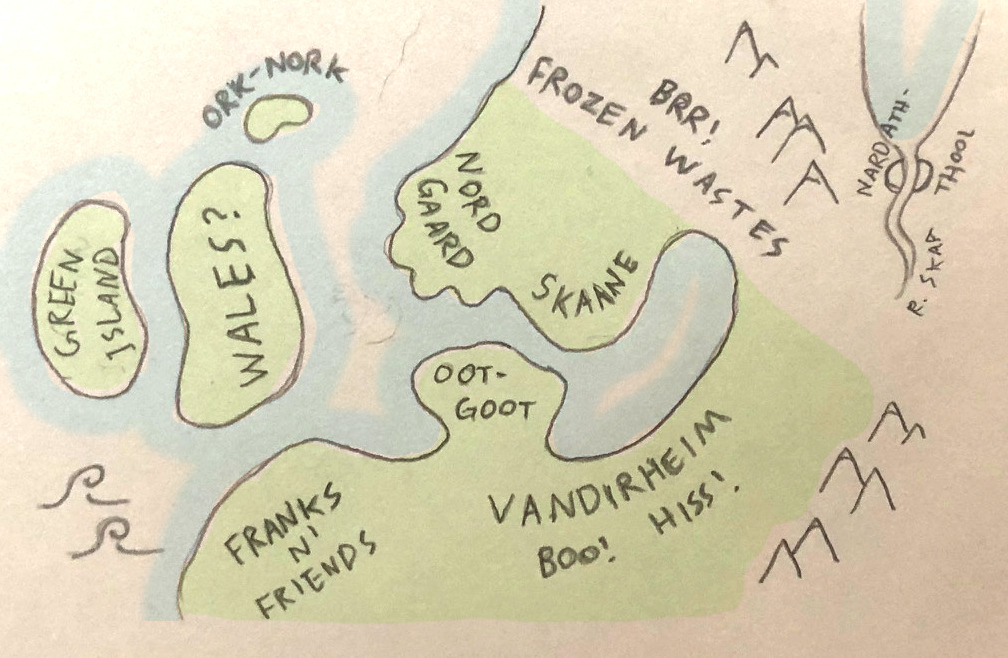
That’s chapter one. Other chapters include “The Chamber of Goom,” “Berserkers!,” and “The Smell of Dungeons.” Obviously our hero receives a portentous quest, but to my delight this one has a table of contents: lion, dragon, eagle, warlock, cauldron, stone, spear, sword, ring. How is this not standard literary practice? Do they not teach school anymore? I won’t run through too much of the plot, because you already know it. It’s everything. This book is a repository of every fantasy trope ever penned. I can spoil details of the story all day and only scratch the surface. You know that scene that would show up in Abbot and Costello movies, where a lady gorilla would fall in love with Costello and not let him go? Yeah, that’s in here. I may occasionally make reference to the glossary, because of course there is a glossary, what kind of book do you think this is? This isn’t your typical kitchen sink fantasy amalgamation. This is what happens when you put every book with a barbarian fighting a lizard over a lady in a metal bikini on the cover into a blender and push “surprise me.” The one thing this book sorely lacks is a map, so I made one. We are told that the story takes place in a fictional distant past of our own world, a la Tolkien, so theoretically we should be able to match places to their approximate equivalents on a boring, normal map.

The story revolves around Hogar’s quest, so what kind of person is this Medieval Gigachad? There are four basic facts about Hogar that dictate his role in every situation. Women will always like Hogar, Lord of the Asyr, no matter what. It doesn’t matter how they met him, what he’s done for or to them, or what species they are. But men? Specifically men in positions of authority? They don’t much care for Hogar, Lord of the Asyr. You see the pattern that’s emerging. Also, anytime Hogar finds himself in a situation, place, location, or time, he’s gonna have to do some fighting. Visiting father’s grave? Time to fight. Enjoying a nice meal? Get ready to fight. Already fighting? Fighty fight! No wonder he says “He who walks apace from his sword is a dead man.” The violence is constant and brutal, but casual, which kind of makes it even harder to read. The final detail that you need to know about Hogar is that his destiny is not his own. The old gods, supposedly long dead, have bestowed upon him a quest, a journey woven by the fates to retrieve the Makkjuffyn. This is a handy way to avoid having to explain coincidences as the plot rolls along, and absolves Hogar of whatever Nuremberg-level crimes he must commit along the way. He has a responsibility to the gods to take no responsibility for his actions.

“She no longer feared what was to come. Still laughing lightly, she said ‘It is but poor, simple fare from my saddlebag that I have to share with you, my lord.'”

A parade of increasingly absurd supporting characters appears alongside Hogar, or arrayed against him. The battle maiden Ragnahild must boink the first man who bests her in deadly combat. There is the evil vampy sex-queen who can turn herself into a sex-tiger, presumably for sex purposes. Yoda is in this book, along with some kind of swashbuckling bard. As I said, men with some authority consistently hate Hogar. But humble, hard working tax payers love him, without question. Even when they should probably have questions. Hogar earns the loyalty of the hale and hearty Svadi by shooting him in the back with an arrow. Some of the Welsh pirates (there’s no time, just read the book) survive for the express purpose of learning to love Hogar. The worldbuilding is quite elaborate. Ermengard (who loves berks) comes from Skaane, the lands (so says the glossary) of the white boar blazon, ruined by the wars of the Vandir and the Nord, home of the aging hero Starulf and the Rhenish race. Skaane (not to be confused with Skona, which is not to be confused with Thone, etc…) hardly matters to the plot, yet even casual mentions of it are dripping with lore. From the fire-worshiping lizard people to the mammoth and tiger frozen in a glacier mid-combat, every page of this book feels like it’s resting on top of ten pages of notes.

Some of Sharpe3’s research seems to have been into efficient cliché packing algorithms. It seems like every tavern in this world has a sign out front reading “Help Wanted: Busty and Bodiced Only,” and every stretch of woods has its shapeshifting demon. The bad guys all kick dogs, and the good guys never kick dogs. I’ve read cliché-heavy books before, but this is on another level, because the disconnected nature of the quest makes it easy to Tetris every last trope into the narrative. Sure, have a sea monster for no reason. And wash it down with airships, why not? Absolute right and wrong with no gray area? Check. Power fantasy hero with no morals whatsoever? Also check somehow.

“Hogar’s point was pressed against the Vandir’s throat, poised for the thrust home. Drakko cravenly threw his sword onto the rushes and extended his empty hands above his head. Cold sweat beaded his pallid brow.”

Not that I’m complaining. Hogar, Lord of the Asyr is written with obvious love for the genre and its antecedents. There is a strong influence from pulpy Burroughs-esque “Shirtless Barbarians of Jupiter” adventure serials, as well as the pseudo-Germanic medieval aesthetic perfected by Tolkien ripoffs. Sharpe really commits to the aesthetic, at one point telling us that something “stinks like an uncleaned hawk mew.” Ah, yes. I think we all know what that smells like. Words I found frolicking up and down the pages of this book include embrangle, sough, fane, sennight, and slumgullion. We’ve got an, ere, and anon instead of if, before, and soon. Things are ensorceled, byrnie-clad, and Daedalian. And of course no one has ever heard of a contraction. Sharpe is best known for writing lyrics, so it shouldn’t be surprising that a trip to his personal word zoo is a delight. The book feels like all the elements of a parody of mid-century pulp arranged instead into a loving homage.

The date of publication for Hogar, Lord of the Asyr is part of why I think it became so quickly forgotten. 1987 was the very end of the Dark Ages of fantasy. You see, in the beginning there was Tolkien. Not literally, of course. Some Brit with too much time on his hands laid out how we got from Ivanhoe to Isengard. But during the 70s and most of the 80s the world of fantasy literature operated on the same principle as Hallmark Christmas movies. Sure, there was the occasional Le Guin or Zelazny, but mostly you had endless regurgitations of J. R. R., and occasionally Burroughs or Lewis. The type fossil of this era is David Eddings. A man so devoid of ideas he could make you stupid by passing his hands over you like Tom Cruise, so disdainful of his own reader that it feels like he’s beating you up for your lunch money from beyond the grave, David Eddings is to the written word what cat puke is to expensive carpets. Here’s a brief aside about one time David Eddings was so racist it broke the story. 1987 marked the end of this inter-dynastic period. This is when Daughter of the Empire came out, and Terry Pratchett was just starting to hit his stride. By the early 90s we had The Eye of the World and some of Terry Brooks’ better stories, and by the mid 90s the fantasy renaissance was in full swing with authors like Nix, Martin, and Hobb. Hogar, Lord of the Asyr is like a beautifully carved crown on the statue of Ozymandius, now buried somewhere in the sand, forgotten in the new world of better fantasy. Maybe that’s why I, a person quickly becoming a historical relic herself, gravitate to these sorts of books. If I’m lucky, some of the other debut novels I read on this blog will turn out to be eloquent speakers for their moment in time.

I’m sure I don’t need to tell you to go buy this book if you can, but it hasn’t been in print for years. There are a few used copies floating around the internet, and I urge you to commandeer one by any means necessary, so long as it doesn’t involve kicking a dog. In the mean time, spread the word. Share this review, or ask your friends if they’ve ever heard of Hogar, Lord of the Asyr. Make it sound like we’re in a cult and this is our holy scripture, because it should be.

Quiz: What’s Not In This Book?

Which adjective is not used to describe Hogar?

Lusty

Ruddy

Doughty

Which of the following is not a fictional place mentioned in the book?

Rhûn, the horizontal realm of rough and ready horse lords

Tarthiz, a Moorish Spain analog stocked with mechanical wonders and swarthy men.

Finnamark, the frozen tundra named after an equally uninhabitable place on Earth.

Which is these techniques does not successfully get Hogar laid?

Bath time ambush

Horse disturbance

Temple bondage

I learned about the greatest work of fiction yet penned, and it has changed my life.

The Wyvern and the Wolf: A Tale of the Twelve Foot Ninja by Nicholas Snelling

Hot Off the Presses scours the internet for newly published books from unknown debut authors, and saves everyone else the trouble of actually reading books to find out if they’re good or not. New posts every Tuesday and Thursday. This is meant for entertainment purposes only, not serious consumer advice. And there will be spoilers.

Today’s entry is meatier than my own gams after the holidays. The Wyvern and the Wolf: A Tale of the Twelve Foot Ninja by Nicholas Snelling is over fifteen hundred pages long. I’d rather share a cross-town express with a freestyle jazz band than drag my eyeballs across that many pages, so we will be doing this a little differently. I’m going to read a random page from each chapter, and let you know what I imagine is happening in the story. I don’t think it will be too much of a spoiler, because I don’t expect to know what’s going on most of the time. Here goes.

There’s been some sort of calamity that ended the civilization we know and replaced it with random Japanese words. Some Mad Max villains show up, but they’re ronin samurai, and impose upon the peaceful villagers for supplies, entertainment, and passage through the blasted wastes. Then things get worse somehow, presumably to kick start the plot. What happens I don’t know and will probably never know, since that was on another page. But the title of the chapter is “The Rift,” so I’m going to assume there is a Doctor Who-style rip in space-time in the middle of someone’s outhouse. Some lady covered in burns is getting scratched in the face by skeletons because a daimyo did something, or somebody stole her children, I couldn’t tell you without actually reading the book as intended, which again, subway car, freestyle jazz. Next we pick up with brothers Keiichi and Kiyoshi, their father the daimyo Jensu, and some general named Hidetado who has a steampunk eyeball. We know it’s steampunk because it has cogs for some reason, and its description includes the word concertina as a verb. All we’re missing is something coruscating and emitting a hiss of vapor from a compressor. A citadel in the fertile south spits out fancy ladies, including one named Nayina, who is hot and I guess married to the daimyo. Like Jensu, Nayina is another name that kind of sounds like Japanese but isn’t, so the sword I carry at all times to detect the presence of Jay Kristoff is starting to glow blue. The calamity (which I have since learned destroyed the moon) also caused a spaceship to fall near our main characters’ home, with the result that salvaging ancient technology is a major industry there. Nayina is killed in front of Keiichi and Kiyoshi by a cohort of ninja, but Kiyoshi is so impressive in battle that he is taken under the ninjissimo’s wing. This is some sort of Tattooine double-sun moment where the hero courageously makes his way to the second act, and the narrative starts to branch out more.

“Weeks passed. Then months. The old man continued to sit in the tree. Eat, sleep, piss, and shit in the tree.”

Another major story line follows a mysterious creature who carries a girl through a desert or forest or both. It tries to find shelter to protect the girl from various dangers, including wyverns, giant soap bubbles, and rabbit liver pâté . At one point he saves her from a giant hostile toad. The girl, it turns out, has a murdered brother, and the tragedy of his death caused a fatal conga line in which every other member of her family died from grieving the previous one. She gets used to her companion, naming him Treeman. After a brief meokbang where she describes his eating habits in nauseating detail, she gets off on watching a bunch of wolves tear a deer apart, so keep an eye on that one.

Kiyoshi is adopted by the ronin ninja that attacked his home, and lives in a boreal fortress that absolutely is not Winterfell for ninjas. When he’s not lamenting the death of his entire family, Kiyoshi gets along pretty well with his ninja lord surrogate dad, step-brother Noboru, and teacher Aeschylus (not that Aeschylus). He hears a story about a legendary ninja named Zuso, who is totally dead now (for real), then starts his training under a “ninjess,” which I assume on another page involved jumping around on bamboo poles. Meanwhile Noboru hurts animals and talks like a psychopath, so I guess keep an eye on that one too.

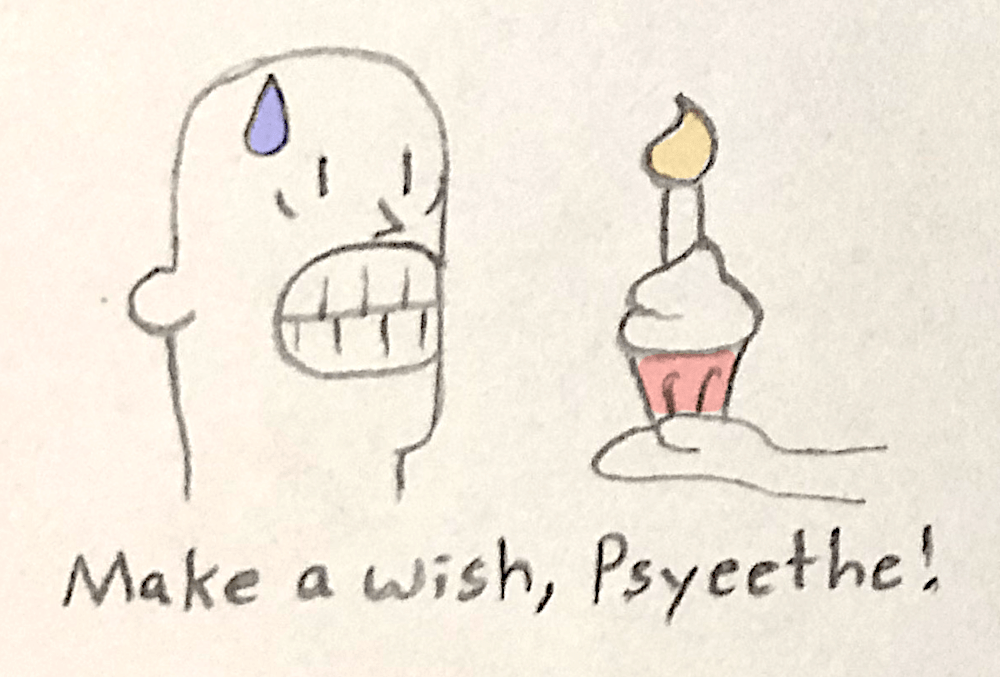
It turns out, Hidetado is alive! But he has been captured by (and partially assimilates into) some hyenamen, led by the cannibal Skaarlog. I was just starting to get the hang of the story when these guys came along. Some nomads called B’eyoodin are here as well, and we know two things about them. They are super into little boy butts, like “dip my hard drive in acid when I die” into it. Also, they are causing worrying amounts of gentrification at Winterfell. These ersatz-Arabs are in turn keeping an eye on Psyeethe-Psyoone, a priest and mathemajician with no lips or eyelids (thank God those Ps are silent, I guess) who licks things to learn about them. He finds an ancient manuscript that predicts the future. That’s all I have for you about that; I am so sorry. All of this happens under the watchful gaze of the Shogun, who follows the age-old tradition of wanton abuse of random underlings to let the reader know they are evil. I’ll stop there, but rest assured all these plot thread collide in some way later on.

“Poise and balance. Breath and exhalation. Strike, parry, and counterstrike. There is a poem in there somewhere, he thought, and made a mental note to compose something properly later.”

The narrative in The Wyvern and the Wolf jumps back and forth without the slightest apology, as if it expects me to read every page and understand what’s going on. But if that’s your thing, I did get the impression that the plot has lots of fun twists and turns, and if you’re some sick weeaboo who gets off on authentic Japanese terminology, but only for swords, then this is your bag. I actually didn’t hate it, and that’s saying a lot for me; I’m such a shriveled raisin of misery that I once managed to dislike a pizza. But this one has character development, setups and payoffs, all that good stuff. At this point I’m impressed when a book concedes to separate each person’s words into their own paragraph during dialogue, but even if my standards were higher I think The Wyvern and the Wolf would feel pretty polished for a self-published debut novel. It’s a steep ten dollars on Kindle, but for once I don’t think that’s too awful, since someone is going to appreciate its length and style even at that price.

If you enjoy watching me try to wrap my mind around a story I only read 2% of, then by all means like this post. In fact, why stop there? You could follow or subscribe or whatever it’s called on WordPress. You could retweet some of that sweet, delectable content on facebook, make some ASMR instagram lifestyle content, show off your Hot Off the Presses lower back tattoos. Go nuts!

I sat through another one of Madeline’s dumb reviews, and now you do too.

Halloween Spooktacular!

Hot Off the Presses scours the internet for newly published debut books from unknown authors, and saves everyone else the trouble of actually reading books to find out if they’re good or not. New posts every Tuesday and Thursday. This is meant for entertainment purposes only, not serious consumer advice. And there will be spoilers.

My first ‘tacular, what a milestone. This year I’ve wrangled four creepy horror or horror-adjacent offerings, so that you can watch me suffer through them like a teenager opening a book bound by human skin. Something tells me I’m not going to emerge from reading random genre offerings unscathed. Knowing my luck I will be covered in scathes, a giant scatheball rolling across the landscape braying “behold my scathes, ye mighty, and despair.”

The first ghoul to darken our doorstep is The Nightmare: A Collection of Deliciously Dark and Twisted Tales by F. B. Hogan. The extremely short and episodic stories in this collection are light on action, and generally don’t waste any time building up an interesting setting, creating a rapid fire, hypnotic experience. What the stories do well is thoughtful, character-focused glimpses. There’s an old amnesia lady, a pioneer girl, a reaper who arrives early, an unfortunate incident with a shoelace, and of course lots and lots of ghosts. The common theme is untimely death, and the prose has a good amount of punch without being cring-inducingly purple. Honestly things were off to a surprisingly good start with this one.

“Tonight the darkness was no friend. I could feel its black tendrils curling about the bed, creating holes and openings for nightmares to creep through.”

Next we move on to romance. Sweet, tender romance. Psycho Hot by M. Rose is your standard queer romance with a twist. Instead of a sexy vampire, or sexy lumberjack, or sexy jerk with an alarming disregard for consent, our narrator is madly in lust with a psycho killer in an insane asylum. Kenneth, recent psychology grad, locks eyes with a serial killer named Darren. To be closer to this absurdly gorgeous killing machine, he applies for a job, and so now he’s the asylum’s shrink because they’re desperate? It doesn’t matter. Darren quickly figures out that Kenneth took the job because of their eye-loving action earlier in the day, setting up a story of quirky gay romance. This thing was baffling, but I guess it shouldn’t have been. So often the masculine lead in these stories is basically a sociopath presented as a dream boat; Psycho Hot peels off the last flakes of veneer and just puts him in an institution for the criminally insane. Psycho Hot is mostly a romance, but does hit some classic horror beats, especially the bimbo protagonist whose sense of self preservation is out to lunch. “Don’t do it! Don’t go in there!” I shouted to myself, more than a few times.

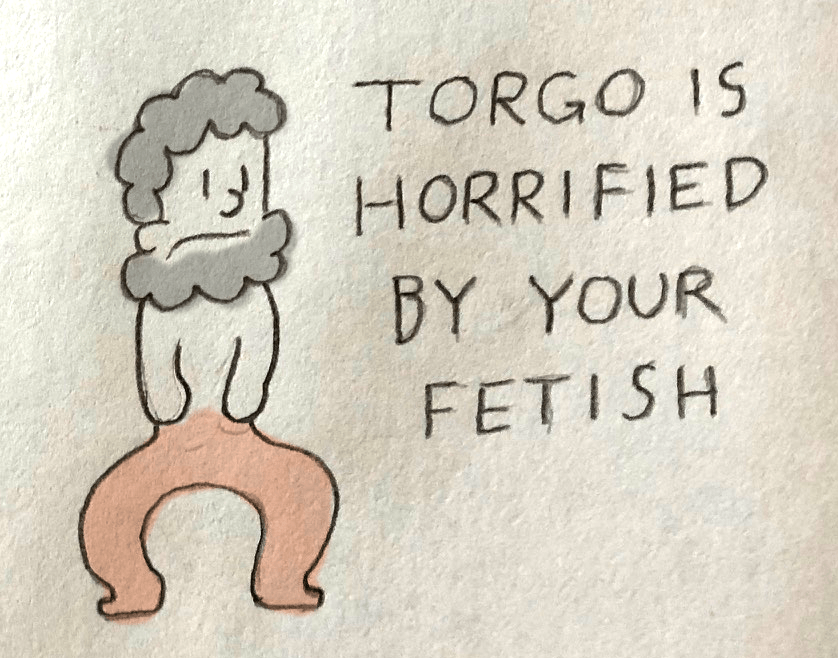
The Dread Queen and Other Dark Impressions by Geoff Emberlyn is another short story collection. We have stories about Torgo from Manos the Hands of Fate running a roadside tourist trap, a man or possibly bird who’s wife has turned out to be a real piece of work, a surgeon who has a special way of taking advantage of the zombie apocalypse, and many others. Compared to The Nightmare, The Dread Queen spends a lot more time on setting, with tongue-in-cheek, tropey plots and a spooky, slasher atmosphere. Some of these stories are acidicly humorous, which was a lot of fun. I think one of the reasons I like Halloween so much is that I can cackle all I want at people being fed into a wood chipper, and when normal people look at me like I’m about to wear their skin to a cocktail party I can say “No, you don’t understand, I just like Halloween.” And then they smile nervously, which I think means they bought it.

“It was a male’s foot, I recall. Not ideal, but one has to work with the parts they can find. Plus, it’s the only foot she has.”

Having just said all that, I’m actually quite a coward. My autobiography would be titled Risk Aversion: The Person. It’s not difficult to find something on Amazon’s new releases that makes me very uncomfortable. What I’m getting at is that our fourth entry in this spooky Halloween post is a little book called Taboo Scary Sex by Corin Tavzitro. From the title and the vampy vampires on the cover I thought this was a horror book, and ultimately I was right, but first I was wrong. It’s erotica. The first story is a diaper-based sex story featuring a sexually active twlve year old narrator. The plot revolves around legal battles over bullying and adoption, and of course lots of gay sex (some of which becomes incest after the adoption, but let’s not split hairs here) that I cannot begin to describe to you here. Now, I have no interest in kink shaming. But reading this story, even out of the corner of my eye, was difficult. And after the first couple of chapters the narrative moves on to other places and characters, but I was braced the whole time, waiting for someone to use the term “soggy baby boyfriend” again without warning. The entire book was like when those Paranomal Activity movies show nanny cam footage of a bedroom, and you’re just waiting for the jump scare. Ten out of ten for fright factor, would have pissed my pants but then I would have had to change (hey, maybe these guys are on to something…).

I’ve said before that there is no ceiling and no floor to self publishing. You can find diamonds in the rough, and also you can find a big ol’ pile of just rough. Most of the time, honestly, it’s Oops All Rough. This year did not disappoint. I found a few legitimately scary stories, and a few bone-chilling moments that probably weren’t intentional. If you’re looking for some scares this Halloween, consider playing new release roulette in the horror category.

I sat through another one of Madeline’s dumb reviews, so now you do too.

Game Over by Elliot Torres

Hot Off the Presses scours the internet for newly published debut books from unknown authors, and saves everyone else the trouble of actually reading books to find out if they’re good or not. New posts every Tuesday and Thursday. This is meant for entertainment purposes only, not serious consumer advice. And there will be spoilers.

Sometimes you feel like reading about middle aged women bonding in a lake cabin over their mutual love of crochet. Sometimes you want dude-dick energy pulsing through the story so hard your Kindle feels sticky. This is one of those stories. Game Over by Elliot Torres is an Evil Boss novel about an aspiring Zoolander who works for the king of video games.

Joaquin Otero is working two jobs in Hollywood to try and make ends meet while he waits for his big break. We first learn what kind of person Joaquin is at his day job processing books at the public library. I don’t blame him for thinking that being a page is like having someone sous vide your brain. You’d never guess it from my expert social skills and not-at-all vitamin D deficient skin, but the proprietrix of this very blog was once a page, and it’s kind of like getting paid minimum wage to sing the alphabet song to yourself until you die or turn into a Batman villain. “Who reads anymore” soliloquizes our intrepid himbo. Who indeed. What’s less relatable is the way he describes his boss as a flamboyantly gay man who is “wearing stilettos in his mind,” and gets a “hard-on” for processing books. A recurring theme in Game Over is that characters will get bafflingly mean introductions or physical descriptions.

Joaquin’s night job is having sex with a bar owner named Will, who is closeted and married with kids. We get a very classy paragraph-long sex scene where Will treats Joaquin like a gym sock, before our boy returns home to his boyfriend Vaughn. Only Vaughn isn’t there. Instead, he left a breakup note, even though he was dating a philandering, misanthropic nobody. Way to shoot yourself in the foot, Vaughn! This blow sends Joaquin into a watching Dirty Dancing and throwing Kleenex boxes at the TV state of mind (I mean not literally, but you know what I mean). Luckily for our hero, the plot swoops in to save the day.

“The glass shattered just like my heart.”

After two years of getting respected and ripped in prison, enormous throbbing badass Mike Chambers is ready to return to his enormous throbbing media conglomerate. The king is royally back on his throne to rule the throne kingdom. His violent video games have made him infamous among angry parents and other squares, but made him a god among gamers. The only sleeves he knows are made of ink. Also, and I’m speculating a bit here, but I’m pretty sure he could arm wrestle a bear. Joaquin has sent out so many job applications that apparently he applied for a stock room job at Mike’s company Imperial, and just when he is at his lowest he gets a call from the big boss’s personal assistant Brenda, saying he needs to start immediately.

Like all fat people in this book, Brenda is always eating. But, and I know you were about to ask, her butt is as flat as an ironing board. Those Dunkaroos and Hot Pockets are going straight to her massive belly. We get an aside about her trainwreck of a life and booze-battered body (even though she is Latina, and so “should have aged well”). Is this a thing? Because this is the second book I’ve reviewed on this blog where a gay male narrator desperately needed to tell me how disgusted he was by a fat woman’s body. Maybe I’m reading too much into it. Anyway, the office is full of nerds “hypnotized” by their computer screens, a black secretary with multiple “baby daddies,” and skinny girls who only work there because of the “lack of competition.” OK, yeah, it’s not just me. Joaquin doesn’t fit in with this crowd. He’s more gym and Botox, less vidya and love handles. He quickly finds out that the boss is a nightmare, but nobody seems very nice. There is a security guard (played in your mind by your choice of Kate McKinnon or Horatio Sans) who is comically hostile to Joaquin, taking time out of his day to taunt him through security intercoms.

“I quickly noticed, in the video game industry, the larger your waistline, hair loss, premature wrinkles, dark circles under your eyes and double chins, the more you were a team player and were rewarded immensely. I, however, was not going to fall victim to that epidemic.”

OK, enough foreplay; we all know where this is going. Joaquin somehow catches the eye and approval of Mike-randa Priestly, and to the envy of everyone else, gets to fill in as Mike’s personal assistant while Brenda is on maternity leave. Oh, did I not mention she is making a whole human with her body when I told you how disgustingly fat she is? Must have slipped my mind. I’ve skipped over some of the subtle clues about just how bad Mike is as a boss, like the fact that employees can’t use the gym at the same time as him, or the grueling procedures his cleaning lady has to follow. But there is one detail that made me laugh every time, and that is the glass breaking. This guy, Mike Chambers, cannot be around glass. Almost every scene he’s in, he breaks something. He probably karate chops his tumbler after a stiff whiskey. And half the time the thing he’s breaking is the glass walls and doors of his own office. He keeps breaking glass and then someone keeps replacing the glass. Why? Take this man’s glass away from him. He can’t have glass anymore. Not stained, not tempered, not even Ira. He’s cut off. After working his glass-replacing temp job for a few months Joaquin discovers that Brenda is not coming back, and he will have to become Mike’s permanent baby sitter. Mike calls her a bitch and breaks the phone, which I assume is his normal way of ending a conversation. Will Man Hathaway survive the boss from hell? Will he give up his dreams of becoming an actor for a six figure income? How fat are women? You’ll have to read the rest of the book to find out!

“It had been two years since Mike Chapman was arrested after a large amount of Cocaine and an unregistered gun was found in his Porsche when he was caught speeding on his way to Las Vegas. He could have gotten five years, but due to his connections and white privilege, he was able to get the sentencing down to two.”

While I didn’t always find Joaquin relatable or likable, this book wasn’t written for me. The story follows the beats of an Evil Boss contemporary perfectly, so if that’s your cup of tea, Game Over could be your next favorite guilty pleasure. The only caveat is, it’s currently ten dollars on Kindle. I would wait for that price to come down, but if you find it during a promotion, it’s worth a look. Especially if you think video games are for nerds.

I sat through another one of Madeline’s dumb reviews, and now you do too.