My Accidental First Date by Casey Morales

Hot Off the Presses scours the internet for newly published books from unknown authors, and saves everyone else the trouble of actually reading books to find out if they’re good or not. This is meant for entertainment purposes only, not serious consumer advice. And there will be spoilers.
Ever wonder what you would get if you crossed Boy Meets World with Tom of Finland? My Accidental First Date by debut author Casey Morales is a memoir about a young man’s awakening following a fateful encounter in the late summer of 1994. This is just the sort of good, clean, sticky fun I’ve been waiting for on this blog. But my luck being what it is, the book is equal parts guilty pleasure and guilty punishment.

Michael, bored at home on a Saturday afternoon, picks up the booty call meant for his roommate. Mystery caller Joseph doesn’t miss a beat and asks Michael to the movies instead. Starting at Joseph’s place, Michael lets us know just how gorgeous this strange man asking him to the movies is, in a purely heterosexual way. This is one of those things where fiction can’t cleave too closely to real life. Here in the world of real humans a straight man can notice that another man’s cheek bones are such a work of art that they are in real danger of being stolen by the British Museum. But in a book with a shirtless dude on the cover, this just makes Michael seem even dumber when he fails over and over to notice that he is gay as a picnic basket.

The fact that they had so many quality new releases to choose from that they didn’t bother to pick until after meeting at Joseph’s condo filled me with nostalgia. Let me just look at my local AMC’s showtimes. Ah, yes, Paw Patrol: The Movie, The Suicide Squad, Don’t Breathe 2, and the most anticipated film of 2015, Black Widow. But I guess the 90s weren’t all fun, games, and being able to support a family on one income, because the movie they end up seeing is Threesome with Stephen Baldwin. Michael, oblivious that this is a date for several more chapters, walks to the theater with his new pal, and notices that on this humid, sexy day Joseph’s curls are sitting just perfectly, and also his nipples are happy. I don’t know what that means, because it’s not cold outside, just the opposite. Does “happy nipples” mean sweaty nipples? A preview for Caligula plays before the movie, which doesn’t make a lot of sense, but maybe it’s the Peruvian soap opera Caligula, I don’t know.

The two share an enticing bag of popcorn and a Sprite. The buttery sex corn and gargantuan drink with one straw for them to both suck on compete for page real estate with a shockingly hostile description of an overweight woman for reasons I still do not understand. Honestly, Michael hates fat women who exist more than words can say. Little by little he realizes that the movie they’re watching while trapped in a room with a large female person has gays in it! And that’s where I will leave you, in the capable hands of Stephen Baldwin and leather-upholstered stadium seating.

Most of the time when I read a first person perspective that’s presented in a very Tom Sawyer, “let me tell you about the time” voice, I don’t assume that I’m reading actual autobiography. But Morales writes with such an incriminating Gen X accent that, whether he shared a wet bag of popcorn with a guy named Joseph or not, I feel like I’ve stared directly into his unvarnished personal history. This is a 1994 where people name their cars Betty, call things they like “little puddin’s” or “that damned twinkle,” and use words like knickknack, minx, and poopedness. The nostalgia needed to write “his sensuous Orville Redenbacher breath” is so localized within a section of late twentieth century middle class American life that I almost feel like Casey Morales has given me his home address. No one could fake this.

The action is simple enough, but gets squished between digressions on various relevant or non-relevant topics. We get a description of the car that nearly totaled ol’ Betty. We get a story about how working for a local politician gave Michael a free movie pass, and how he felt guilty about it (Imagine—seeing a movie for free! Who could live with such crimes?). The lengthy paean to stadium seating, the hot new innovation in movie theater design, left me wondering if maybe our author went on this date in 1974. We hear endless details about his Christian upbringing and love for green Boy Scout socks. There’s a fable about a Native American medicine man and his message of Catholic guilt. There are several places where the word “anyway” gets its own paragraph. Flipping through this book is like listening to your dad’s friend at a barbecue pay out a long, meandering story, in the hopes that it will eventually turn into gay erotica.

And it does! I won’t spoil it too much, but suffice it to say, there are penises in this book. Of course, it wouldn’t be possibly-Boomer-posing-as-Gen-Xer erotica without some good old fashioned creepy sex tropes. This is one of those stories where people push through another person’s resistance because they’ve read the book and they know it ends well. But our reluctant gay-to-be Michael gives plenty of signs that he is not interested in Joseph’s advances at first, including at one point looking “scared to death,” only to be creeped into submission. Massages, man. If only Aziz Ansari had known about the power of massages. The version of gay life portrayed here is understandably dated (it took me an embarrassing amount of time to realize that the fact Joseph owns antiques was supposed to be a giveaway), but this is a pretty cringy way to write any sexual encounter that is being portrayed as a positive moment in a young person’s life.

I understand that I am the last person to evaluate one of these books as good or bad. How do I even determine if this is worth your time when there are literally hundreds of gay romances published on Amazon every nanosecond? And what are my credentials, anyway? If a normal person faced the profundity of what I don’t know about sex, it would look like the theater scene in A Clockwork Orange. But I will say this. I expected a book with some dicks in it, and I got a book with some dicks in it. That’s gotta be worth something.

On a serious note, however, four dollars is a little steep for the length. Maybe wait to pick it up during a promotion.

I sat through another one of Madeline’s dumb reviews, so now you do too.

Rutchit: The Adventure Begins by Richard Rogers

Hot Off the Presses scours the internet for newly published books from unknown authors, and saves everyone else the trouble of actually reading books to find out if they’re good or not. This is meant for entertainment purposes only, not serious consumer advice. And there will be spoilers.

I’ve read a lot of books about the gradual erosion of sanity, about a mind being chipped away like a boulder by the sea. But it’s a rare treat when the piece-meal psychological breakdown is the reader’s. Rutchit: The Adventure Begins is definitely a book. That is one fact I can pin down and not expect to fly away the moment my back is turned. It was probably summoned into existence by a real person named Richard Rogers, and was published less than twenty four hours ago when this post was made. At least, I think so. Right now I wouldn’t be surprised if I looked in the mirror and saw Robin Williams from Jumanji staring back at me. I wish I could tell you what this book is like, really I do. But I can’t. I can only try to explain what happened to me when I read it. I promise I’m not crazy.

Rutchit: The Adventure Begins follows Rutchit, a Rutchiti warrior and Chosen One as he and his revolving cast of friends battle a revolving cast of enemies, most of whom are also Rutchiti warriors. The story mostly consists of a series of battles and maneuvers between the two shifting groups, with some travel and fetch quests thrown in for good measure. Let me see if I can summarize the prologue. We start in 1720 somewhere with the trial of Crazy Fred, who escapes confinement. He battles and kills the leader of the Rutchiti before being killed by Dominick. But Fred’s supporters revive him with a Rutchiti stone, only his name is now Ricardo, which isn’t a name he chose but he likes it enough that he gets upset whenever people call him Fred from this point on. Ricardo then kills Dominick, who is also revived, but I guess they pulled him out of the printer too early because he comes out ugly and has a tail and also his name is Sinserious now. There’s a kidnapping, a showdown, a rematch between Sinserious and Ricardo, and the conspirators are sentenced to death by whale while Ricardo’s minion Mookcoo flees in a balloon. It’s now around 1980, and Sinserious meets and picnics a girl named Lily. The progression goes as follows: picnic, cohabitation, pregnancy, miscarriage, wedding. Then two more babies are born, Twinkle-Star and Rutchit. But gasp! Ricardo is back! In his efforts to kill the two babes he mortally wounds Lily, who Sinserious must then dispose of in a volcano.

And that’s where our story proper begins. The entire thing is written in the same voice, with the same slang and spelling errors (the consistent “could of”s are easy enough to tune out, but it took me a while to understand why someone would “elect” out of an airplane), rarely punctuated, with no paragraph breaks, and not properly formatted for Kindle so it lacks discernible line breaks as well. Oh, and every word is capitalized, which I legitimately did not notice for hours because it was the least distracting thing on the page. Here’s a representative sample, although for full effect you’ll need to pretend there are a few more cutaways to characters shouting early 2000s internet slang at each other:

“Then 3 Vampire Bat Birds Attacked And Rutchit Got Smacked Around And Kicked Until Him & Sasquash Teamed Up To Deal With The First One By Having Sasquash Distract Them Long Enough To Charge Up His Rutchiti Blast To Blow It To Bits.”

Sasquash is a lion friend. I’m pretty sure he showed up in chapter three, because these are my notes from chapter three:

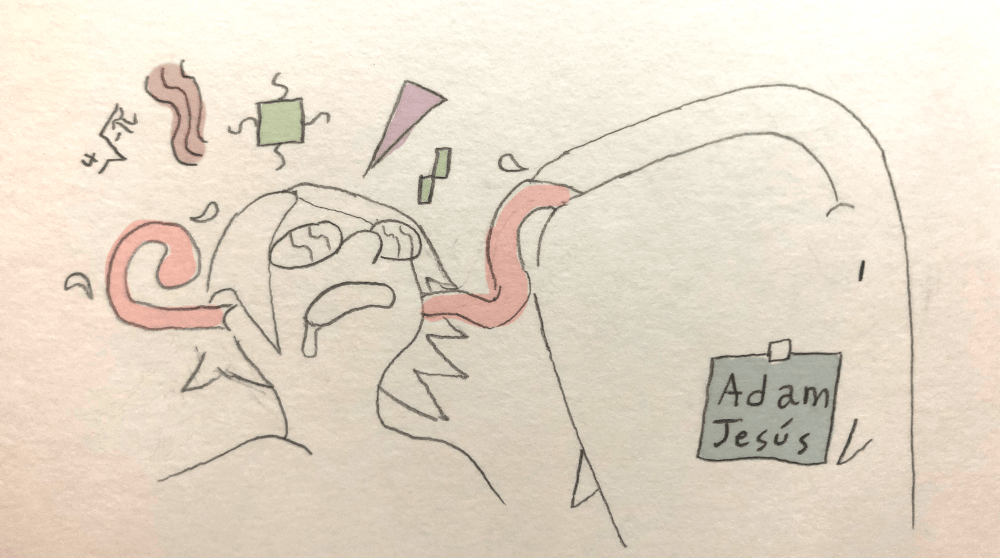
“Rutchiti jet fighter, serpent slash, Sasquash, Rutchiti = planet?, escape parachute, whale shark = Adam Jesús”

The plot is cyclical, with each crisis leading into the next without betraying any hint that the previous plot point has been resolved. Every battle plays out as a slight variation on a pattern, often involving the same people in the same location as a previous battle. The oozing sponge of a plot, combined with the edgeless run-on sentences creates the feeling of a Nichiren Buddhist chant or a Shephard tone; it gives the illusion of progress without leaving one spot. I found myself looking down at the percentage in the bottom right of my Kindle every few minutes, just to ensure it was still going up. I’m almost surprised it never winked at me. At some point our heroes visit a nearby galaxy, encounter talking trees, and visit a candy castle. There’s a fight in which they are briefly pulled into the “3-D dimension,” then safely returned, leaving me to thirst for explanations I knew I would never taste. I won’t spoil the ending, but honestly I could just say anything. How do I even know what I read?

Any time I feature something on this blog I want to make sure that I’m not doing anyone dirty. At first glance this looked like something Neil Breen would cough up after swallowing a typewriter, i.e. fair game. But as soon as I started reading the book this assumption was shattered, and replaced with coruscating layers of urgent bewilderment. Was this written by a ten year old in Serbia, and I am the literary equivalent of someone hurling insults at children on a Minecraft server? The idea occurred to me that this was never intended to be judged as a piece of literature, but was cobbled together by a group of students as a class project. Another idea came slowly into focus as I read. You may remember Lark Voorhies as Lisa Turtle from Saved by the Bell. In real life Voorhies suffers from Schizoaffective Disorder, and wrote a book in 2011 in which every page looks like this:

By, the, tides, we, have, carry, to, the, answer, and, rotation, of, the, prime, station, of, known, proof. That, the, composite, effective, has, windtried, the, focal, placement, of, real, treasure.

Could I be taking the piss out of someone with a similar condition? A quick search brought me no closer to understanding, though it seems that the book was the product of a would-be video production company. Someone has been creating Twitter, facebook, and Youtube accounts for Richard Rogers, RutchitiWarriors, RutchitVideo, etc., but they are almost entirely empty, and mostly interact with each other.

Would I wish this fate inflicted on another? Kind of. Once I squished my brain back into my ears, I was impressed at the level of follow through in Rutchit: The Adventure Begins. This book made me feel like I was being gaslit by the universe for hundreds of pages without interruption. The current price is five dollars on Kindle, which is way too high, but if it’s ever on sale, pick it up just to confirm that it is real, and I didn’t imagine the whole thing. I promise I’m not crazy.

I sat through another one of Madeline’s dumb reviews, so now you do too.

The Soul’s Aspect by Mark Holloway

Hot Off the Presses scours the internet for newly published books from unknown authors, and saves everyone else the trouble of actually reading books to find out if they’re good or not. This is meant for entertainment purposes only, not serious consumer advice. And there will be spoilers.

In our inaugural installment, we’ll be looking at The Soul’s Aspect, a YA fantasy novel from debut author Mark Holloway. This may sound like a dangerous precedent to set, but hear me out: I’m going to walk you through most of this book. I won’t spoil the end, but we are going to gawk and gape our way through the strange reptile house of fantasy tropes that Holloway has seen fit to build. You’ll see why I’m doing this.

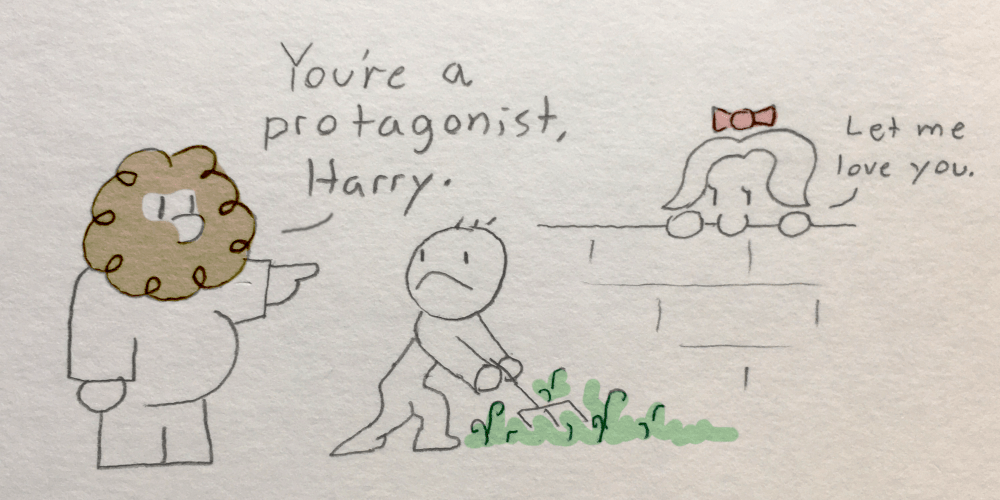
We begin in a small farming village with about a half dozen named characters, including our young protagonist, Kermit. The widower father makes vague allusions to the Jedi that his cousin’s former roommate once knew, and gives his son a debilitating concoction that’s totally not dulling his secret Jedi powers. Honestly, this isn’t the worst foreshadowing, because in this teenage power fantasy we know the lad has to be a Jedi sooner or later. But at this point I think it would be more of a surprise to find a picturesque hamlet whose chief export is anything other than protagonists. We also get our love interest, Eva. Better get used to that name, because you’re going to see it a lot in this book, and most of it consists of Kermit repeating her name over and over (sometimes augmented with descriptions of hair color), because we learn bugger all about her. She is the first act love interest Mark II, less two dimensional damsel in distress, and more two dimensional blandly competent person who has even less reason to settle for this dork. Oh, and one more detail: her family makes candles. Is this a fantasy trope, or am I going crazy? It seems like the home town love interest is always a chandler in these things. I’m not complaining; I think this is a positive development in metafiction. Anyway we’re calling her Molly from now on for no reason, no reason at all.

Kermit spends his days being told by every living creature on Tatooine that he needs to tell Molly how he feels, which is our first of many tropes that really need to go away. I don’t know how clearly you all remember adolescence, but I don’t remember a time when emotionally burdening others with my awkward desires was a good idea. Of course it’s fine; she’s totally into him because he’s the protagonist and oh look, it’s another trope that needs to die a horrible death. Luckily, before Kermit can monologue about how much he hates sand or whatever, a Grisha comes to town and takes Kermit away for his training. Since this is mandatory military training imposed by an occupying power, I was surprised to read this described as a “rescue,” but hey, parents be trippin’. Kermit disowns his father and says his farewells to Molly, who is remarkably chill about having a kidnapped wizard boyfriend.

So obviously in this teenage power fantasy, our protagonist is a prodigy in magic. Magic in this world is presented as mechanistic, and for a few pages I wondered if the twist was that it’s just steam and the simple farm folk of District 12 can’t wrap their minds around such a concept. But no, it’s standard sword and sorcery magic. We have two countries, the conniving wine sippers known as the Vin, and the hearty ale-quaffing rustics known as Caesarians. They have some other name, but that’s the only way you’re going to be able to read it so don’t fight it. Anyway, the Jedi whisks Kermit off to Hogwarts and along the way we meet obvious future sidekicks Ensign Kif and Broch. Broch is described as a philandering, self-absorbed, privileged student, so good luck not calling him Brock Turner in your mind for the rest of the book. Don’t worry, he’s gay. It’s fine. Kermit saves Brock’s life using a diagram he found in a book Ensign Kif showed him to stop a deadly infection. This establishes two things: first, that given sufficient talent, magic in this world works like youtube tutorials, and second that our protagonist is effortlessly, one might almost say suspiciously, perchance even foreshadowingly, good at magic.

Kermit’s excitement at approaching the Little Palace gives us our first glimpse at our target audience, when he complains that he never made many friends back in Uwe Bol Village because he was a specky, medicated indoor kid obsessed with books. YA fantasy always appeals to this demographic, but part of the power fantasy usually involves becoming the celebrity jock, and I found it quite refreshing that for the entire book our reader insertion main character is an utterly hopeless dweeb. Apparently he thought this was going to be a rather perfunctory abduction, because he is surprised to learn that the training generally lasts three years, maybe two for the very advanced. Incidentally, this is also how long it takes to graduate law school.

Buckkeep School of Law exposes our plucky hero to some new ideas. The sight of a woman doing a thing causes him to shrug his shoulders and wonder why we don’t just all not have any sexism (I mean, we’re still not going to pass the Bechdel test, let’s not be hasty). This is another classic trope that will pop up a few times: our reader insertion has to expressly assure the audience that his moral sensibilities are strictly modern. In The Soul’s Aspect this is always done as clumsily as possible, and usually leaves me confused because we rarely get any context for these beliefs. We don’t know how open-minded society is in general, and on the rare occasion that Kermit has to change his perspective, it’s not clear that he had any strong preconceptions in the first place. We get some similar head-cocking and shoulder-shrugging as Ensign Kif tells us a little more about the aspect, the substance that binds together the flow of energy and all living things.

I’ll let you in on a little secret. I am a sucker for good worldbuilding. And when I say “sucker,” I mean it. You can sell me a full price ticket to the worst movie of the year if there’s an extended scene in which Alfrod The Wise explains how furlongs are measured differently in each province of the realm. I once sat through the entirety of Shadow and Bone, and it sure wasn’t for the creepy teen-girl-gaze gay sex. A boilerplate fantasy novel can keep me in my popcorn if it just metes out enough information about language, culture, what people eat when they’re hungover, etc. So I was disappointed when they finally get to Buckkeep School of Law and it’s just nothing. In my mind’s eye, I pictured the entire campus as a series of gray concrete hallways like some Brutalist university parking garage, because I had nothing else to go on. They have zipline elevators, and various rooms with names like “dormitory” and “study hall,” and I guess there’s a lake nearby? But who knows what any of this stuff looks like, or smells like, or tastes like. Come to that, Holloway has a habit of telling me about things I would rather feel. Apparently sometimes there is incense, but I don’t know what kind. Sometimes the characters eat food, and we get descriptions like “a bowl of rice and some eggs.” The main character eats curry for the first time, and calls it “spicy,” so I guess I should be grateful for that. I Guess what I’m saying is that this setting is such a blank slate we have no choice but to goose it up a little as we go.

Kermit wanders his way through the second act from room to room, generally overwhelmed by Vin racism, academic regulation, and naked public bathing. One of the aspector teachers kills a rat, so that’s them confirmed for villains later in the book. The roommate triumvirate is complete with the arrival of Thain Longbottom. Kermit is learning to use magic for evil, and to his dismay this includes gym class. I cannot explain to you how much I love the fact that the latest challenge to face this magical prodigy in a power fantasy for teenagers is running laps. The Supreme Soul gives him a side hustle among the seers, the monk-like order parallel to the aspectors, and Kermit’s life settles into something resembling a routine.

At one point Brock is forced to work at the library as a punishment, which checks out because he is currently studying fabricating, which is basically wizard engineering. True story. I once asked a graduate of an engineering school, who lived on campus, where the library was and got “I don’t know” as a response. These are the people building your freeway overpasses. Anyway the library smells like garlic bread and just-blown-out birthday candles because every library should smell amazing and who’s going to argue with me about what the setting is like? Mark Holloway? There the gang meets Atlanta the librarian, who copy-pastes the author’s worldbuilding notes about the heretical religious side of the aspect. Meanwhile capitalism strikes again, because apparently conscripted military service is not free, and Kermit gets a job at the local watering hole when he’s not becoming exponentially stronger in the use of magic. I can’t recall anyone explaining what prevents wizards from just magicking their way through a part-time job, but I guess it’s not allowed. As Kermit starts to learn more about the aspect and his own abilities than he is meant to know, and the three Caesarian students learn the extent of their second class citizenship within the Vin empire, they begin to hatch a plan to train themselves in secret. When their training brings them closer, Neville and Brock fall in love. Kermit assures us over and over that he approves of his friends being gay, but honestly he could save his breath. The Sword of Damocles is dangling so low over these two it’s peeking into frame like a poorly handled boom mic.

The training becomes more intense as Kermit’s abilities agitate the Vin leadership of Buckkeep School of Law. P. E. now includes sparring practice, and Kermit is deliberately paired up with Frinkle, the rich, racist bully. This really highlights some of the weaknesses in unrelated and legally distinct works like Harry Potter: if Malfoy had just focused on getting swol, he could be his own Crabbe and Goyle. Again, there is no solution to Kermit’s physical limitations. He just gets the snot beat out of him repeatedly, and it never gets any better. I love it so much. The scene is set for the ultimate showdown, in which Kermit and his friends must face the wrath of irate school administrators.

As I approached the final act of this book I felt like I could predict everything that was to come. I had already reached the point where anytime a new character appeared I was immediately replacing their name in my head with the corresponding character in Harry Potter. I had it all mapped out: Ensign Kif’s redemption arc, Molly’s urgent distress message, the wacky escape through the sewers, the decisive battle against mini-boss Frinkle. I really was not prepared for what I read. The ending of this book is bananas. If you take those words literally, and assume the third act of The Soul’s Aspect is just sketches of bananas in different lighting conditions, you still would not be prepared for how off the rails this thing goes.

I originally felt bad about spoiling most of the book and ridiculing a debut author for leaning so heavily on tried and true genre tropes. But as I started writing I realized that I was going to get to the end of this rant with a pretty solid recommendation. The Soul’s Aspect is brazenly cliché, and doesn’t always pull off those cliches well, making me nostalgic for earlier iterations of the same ideas that did them masterfully. But I was never bored, even when I was rolling my eyes in disbelief, and I wasn’t kidding about the ending. It’s worth it. So there you go, Mark Holloway, by way of apology I’m telling people to go buy your book. It’s four dollars on Kindle, and I can only assume there will be a whole trilogy about the continuing antics of Kermit the Wizard.

I sat through another one of Madeline’s dumb reviews, so now you do too.